Day 14, from my 30 days of grief prompts.
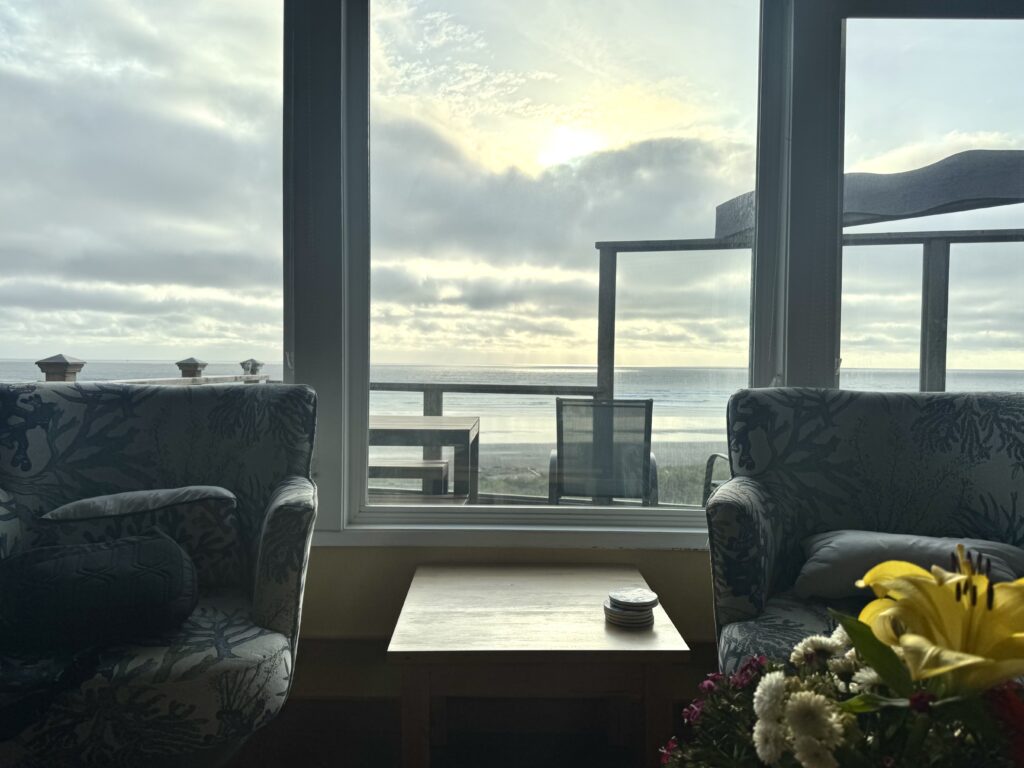
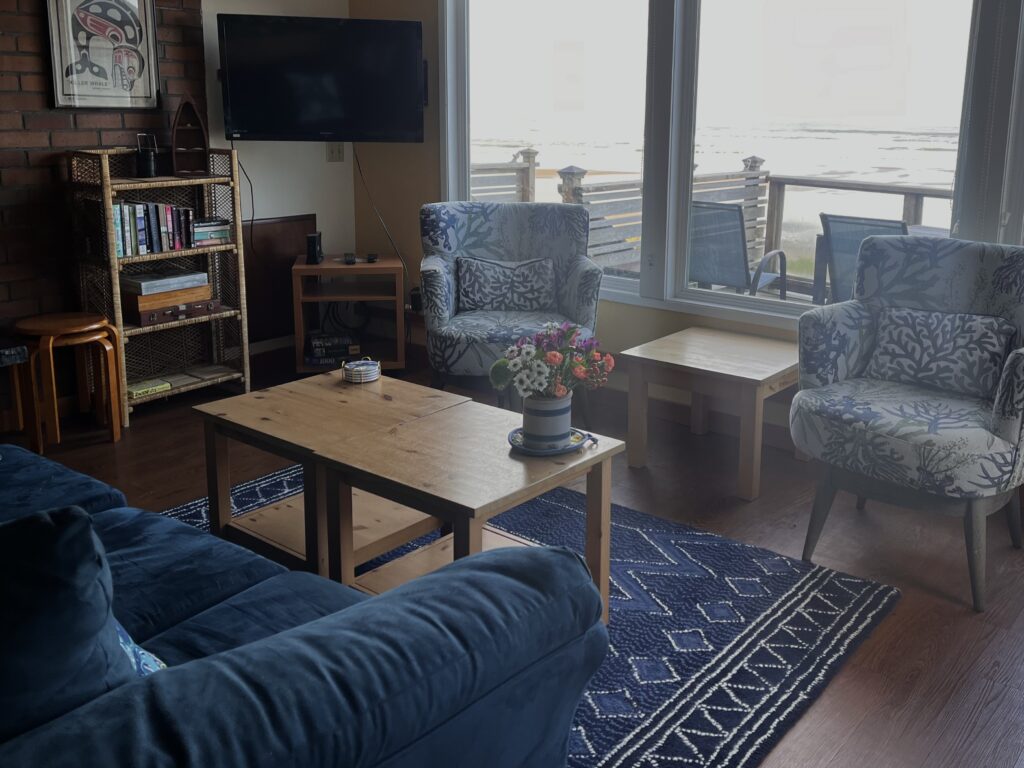
The blue couch… so much joy and so much sadness
Where would I take you? If I could. I didn’t have to think long on this one. The answer felt as if it was waiting for the question to be asked. The Oregon Coast. I would take you to the Oregon Coast, Emery. It would be April, because it is April now, and even though you prefer sunny days to rain, I’m not worried. You are going to love it as much as I do.
After Dad died, and my sister was diagnosed with an incurable cancer, Emery helped me with daily calls and reminders to breathe, promising it would get better. “Put your hand over your heart, Mom, and inhale and slowly exhale. I’m here.” In my journal pages, I found the only entry written from those days.
“I know I’m depressed. I know I should go hike or, at the very least, walk around the block. I don’t ever remember feeling this down.” I felt like I had hit rock bottom, and Emery was helping me find my way out.
I remember during those dark days, Emery telling me she wanted to take me somewhere, anywhere really, because we needed a mother-daughter trip. She mentioned pink champagne and shopping for things we didn’t need. She wanted to mother me, and I wanted to let her. Four months later, Emery died, and what I thought had been my rock bottom would go deeper than I ever could have imagined. I returned to Manzanita, Oregon, a few months after she died, to the same house I had rented the year before, but this time it was vastly different from the previous year. I was deep in grief. My rock bottom became a dark cave with only slivers of light coming in. I don’t remember much about that month, and given the state I was in, I’m not sure how I fed myself or functioned with the day-to-day tasks of being human. I returned to the coast because I wanted to be inspired and held by the ocean while I wrote, walked the beach, cried, and grieved. I responded to writing prompts focused on grief, and in doing so, I’m playing out the fantasy that Emery is still here. At least in my words. We are still planning.
We are sitting on the blue couch, looking out at the ocean from the living room’s large picture windows. We could sit outside on the deck, but it’s chilly this morning, and inside feels cozier. I turned on the fireplace and poured a cup of coffee for each of us. I’m sorry, Emery, I don’t have matcha, as I know that’s what you’d prefer.
The beach is empty except for one man and his dog. He’s out every morning, rain or shine. He and the dog will be back for sunset. I know you’ll be watching the dog more than the man, wondering its name and wishing you were on the beach so you could pet it. The sun is out now, although there will likely be a pop-up rain shower later today. You sigh. I think you love it as much as I do, and I think you’re surprised by that, because, as my sun-loving daughter, you didn’t like rainy days.
You tell me how beautiful it is, the waves crashing up on the beach. We feel so close, even though we are inside. You tell me you’ve always considered yourself a mountain girl, and now you wonder if maybe you’re an ocean girl instead. I tell you, I think you can be both, as I feel the same way. You tell me you understand my love for this magical place. That makes me happy. And now I sigh as I write, because you didn’t see the beach or the small town where I rented the house. You did, however, see Cannon Beach, just north of where I was staying. We went with two other families and spent several days there. You were five. You liked everything at five, except naps, so of course you liked Cannon Beach. I know you‘d remember that vacation, or at least pieces of it, because one of your best friends was also there. We were a group of 14. We didn’t move through the coastal town without a lot of attention and likely exasperated sighs from the waitress at the restaurant we claimed ours for every breakfast and several lunches. So you had been to the Oregon coast, but not where I have landed now, and not as an adult, nor have you ever sat on the blue couch with me while looking out at the ocean. I set those thoughts aside and return to the fantasy I’m writing.
We quietly watch the sea, seated next to each other on the blue couch. The sun comes out, and we bundle up and head down to the beach. You wear one of my jackets, and it’s huge on you, but, like everything else, you wear it well.
We walk across the street to the six steps leading down to the beach. You stop at the bottom step to soak it all in and marvel at the beauty that I’ve talked about so much. We turn right, towards Neahkahnie Mountain, the beach nearly deserted. You ask me if it’s always like this, so few people, and I tell you yes, but then again, it’s April, not a popular time for beach goers. Even a dozen people would feel crowded to me. I’ve been spoiled. I’ve gotten used to the solitude of this beach in April.
We find a large piece of driftwood and take a seat. I point down the beach to the tide pools, and tell you it is where Thomas and his girls walk from the house they rent to look for starfish. You tell me you want to go there later and look for yourself. She’s making plans. She loves it.
You tell me it is the perfect place for a writer, and I agree. You asked me to show you the spot on the beach where I saw the lineup of people and the girl in the yellow raincoat holding the box, which I believed contained ashes. I pointed it out to you, and you told me you thought the story I wrote was one of your favorites. I didn’t know when I wrote it that less than nine months later, you would factor into another essay inspired by the girl in the yellow raincoat with the box of ashes, but the actors would be different. It would be your family. A mother, a father, two brothers, a husband, and two children.; all trying to make sense of something that doesn’t. All grieving your death. But now, you’re with me, while I experience the gift of having you, in a fleeting moment of creativity that I have formed with my words.
As we walk back to my rental house, you stoop down to pick up a heart-shaped rock and start to put it in your pocket, but then hesitate and set it back down on the sand. Why didn’t you take it, I ask? You know, for a little souvenir? You tell me that you don’t need to take the rock because you have the memory of finding it while walking on the beach with me, and that’s enough. Of course, that’s what you say because that’s who you are. I remembered being with you once and you finding something on a sidewalk. Was it a penny? Probably. You decided not to pick it up, but instead, wanted to leave it for someone else to find. I think about that now when I see a coin on the sidewalk or the floor, but I pick it up, because now, I see it as a gift from you, intended for me.
It starts to rain, so we return to the house and our place on the blue couch. You lean into me and put your head on my shoulder, your eyes fixed on the beauty of the ocean through the filter of light rain. I can see why you love it, Mom. I’m so happy you’ve found this piece of heaven.
That is where I would have gone. That is where I would have taken you.
I shift out of my fantasy and back into my reality. I have a deep longing for something I have never experienced. A longing for the endless possibilities I thought lay in front of us.